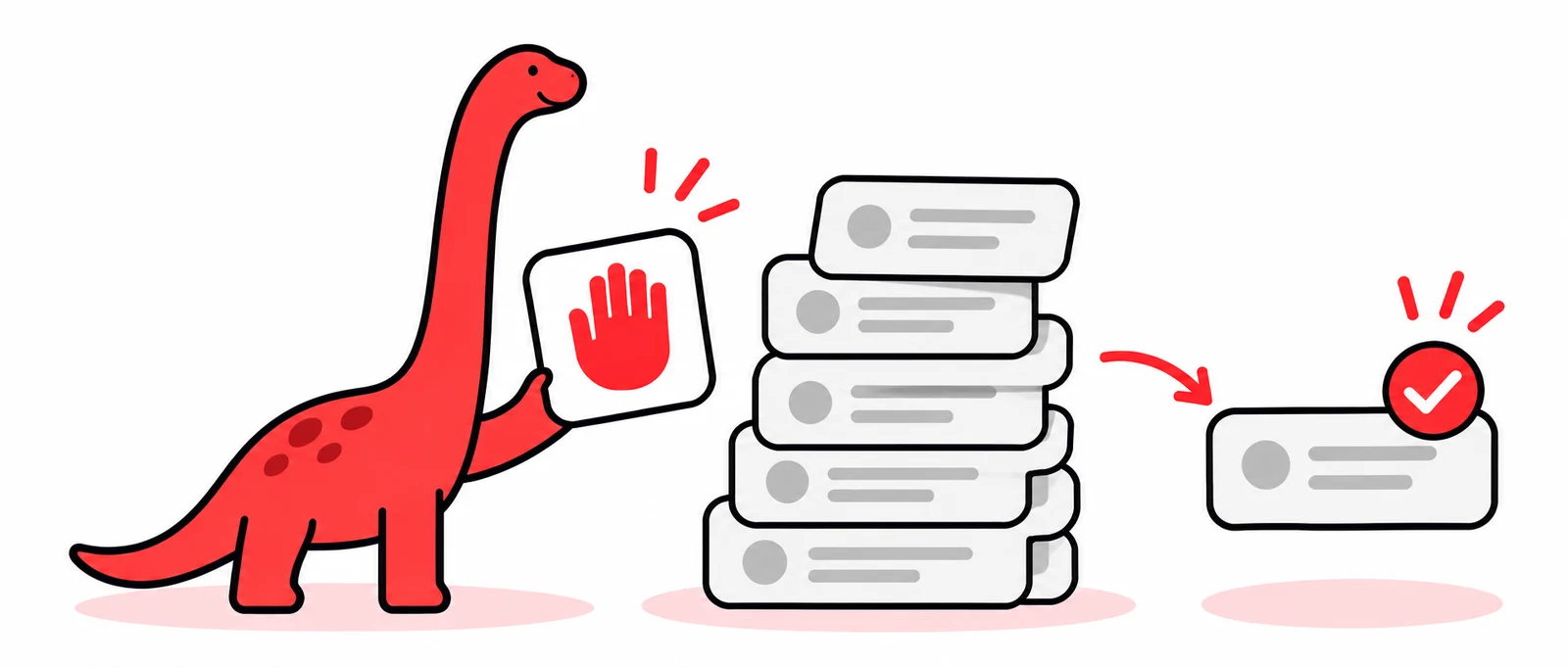
Most of my job is saying no.
Not because the ideas are bad. Most feature requests I get are reasonable. Someone saw a problem, thought of a fix and brought it to the person who can make it happen. The trouble is that there are always ten reasonable ideas and room for two.
I wrote about product sense as knowing what to do, when, why and when to say no. The last one is the hardest to do well, because a bad no costs you more than the feature. It costs you the next idea that person would have brought you.
Here’s how I say it so the relationship survives.
Start by understanding the ask, not judging it
The worst no is the fast one. Someone describes a feature, you already know it’s not happening, and they can hear it in your voice before you’ve said a word.
So before I answer, I ask questions:
- What happened that made you want this? There’s almost always a specific moment: a complaint, a number that dipped, a competitor’s screenshot.
- Who is it for? Guests, a store team, a partner, a leader who asked them about it.
- What would be different if we built it? This is the outcome, and it’s usually more useful than the feature.
Half the time, the feature isn’t what they need. A request for a promo banner on the home screen is really “this campaign isn’t getting seen.” That might be a banner. It might be a push message, a menu placement or a fix to the offer that nobody can find. Once you’re talking about the problem, you’re on the same side.
Say no to the timing, not the person
Most of my no’s are really “not now.” I try to say that honestly, and say what it would take to become a yes.
The answer has five parts:
- What I heard. Repeat the problem back in their words, so they know it landed.
- What we’re doing instead. Name the two or three things we’re working on and why they come first.
- The trade-off. “If we build this now, this other thing slips.” Make the cost visible. People accept a no much more easily when they can see what a yes would cost.
- What would change my mind. A number, a date, a dependency. “If the campaign’s redemption is still under target after two weeks, I’ll pull this forward.”
- What happens to the idea. It goes on a list, and I tell them when that list gets reviewed.
That fourth part does most of the work. A no with no way back feels like a wall. A no with a condition feels like a plan.
Use the strategy, not your opinion
If the only reason for a no is that I don’t like the idea, I haven’t earned the no. The reason has to be the thing we’ve already agreed on.
That’s why a clear vision and a short list of goals matter so much. When the team has agreed that this quarter is about checkout conversion, a request for a new loyalty tier isn’t me against them. It’s the request against the goal we all signed up for. I can point at it and ask, “Does this move it more than what’s already on the list?”
When there’s no real strategy, every no becomes personal, and the loudest person wins. I’ve written about how strategy theater looks like a plan but can’t settle an argument. This is where you feel it.
Bring evidence, but don’t hide behind it
Data helps. “Two percent of guests open that screen” ends a lot of debates. But I try not to use numbers as a shield. Data and instinct both have a place, and stakeholders can tell when you’ve gone looking for a chart to justify a decision you’d already made.
If my no is a judgment call, I say so: “I don’t have data that proves this won’t work. My read is that it adds a step to the flow we’re trying to shorten, and I’d rather not take that bet this quarter.” That’s honest, and it’s easier to respect than a dashboard waved around like a verdict.
Keep the parking lot honest
Every team has a list of ideas that didn’t make the cut. Most of those lists are where ideas go to die, and everyone knows it.
Mine gets reviewed on a schedule, usually at quarterly planning. Each item gets one of three outcomes: it’s in, it’s out for good, or it stays parked with a reason. When I tell someone their idea is on the list, they can check. And when something does come off the list and ships, I tell the person who asked for it. That one message buys more trust than any number of polite no’s.
When to say yes anyway
Sometimes the right answer is yes, even when it isn’t on the plan:
- It’s small and it removes real friction. If it’s an afternoon of work and guests feel it every day, the cost of debating it is higher than the cost of doing it.
- It’s a store team asking. The people working the counter see problems before the dashboard does. I give their requests more weight, not less.
- I was wrong about the priority. If the questions in the first step turn up something bigger than what we’re working on, the honest move is to change the plan.
A no is a decision, not a reflex. Treat it like one.
What I’d do Monday
Pick the last feature request you turned down, or the one you’ve been avoiding. Go back to the person with the five parts: what you heard, what you’re doing instead, the trade-off, what would change your mind and when the idea gets looked at again.
You’ll probably still be saying no. But they’ll leave knowing why, and they’ll bring you the next idea.