For most of the last year, I rolled my eyes at the word “agentic.”
Every demo looked the same. An AI books a flight in fourteen steps that I could finish in three taps. It fills out a form slower than I would, then asks me to confirm it filled out the form. The pitch was autonomy. What I saw was a slower, less reliable version of things that already worked.
I’ve spent fifteen years taking taps out of checkout flows. Putting a chatbot in front of a perfectly good app felt like going backwards. Hype is not a user need, and agents looked like hype.
Then I stopped watching demos and started building.
What changed my mind about AI agents
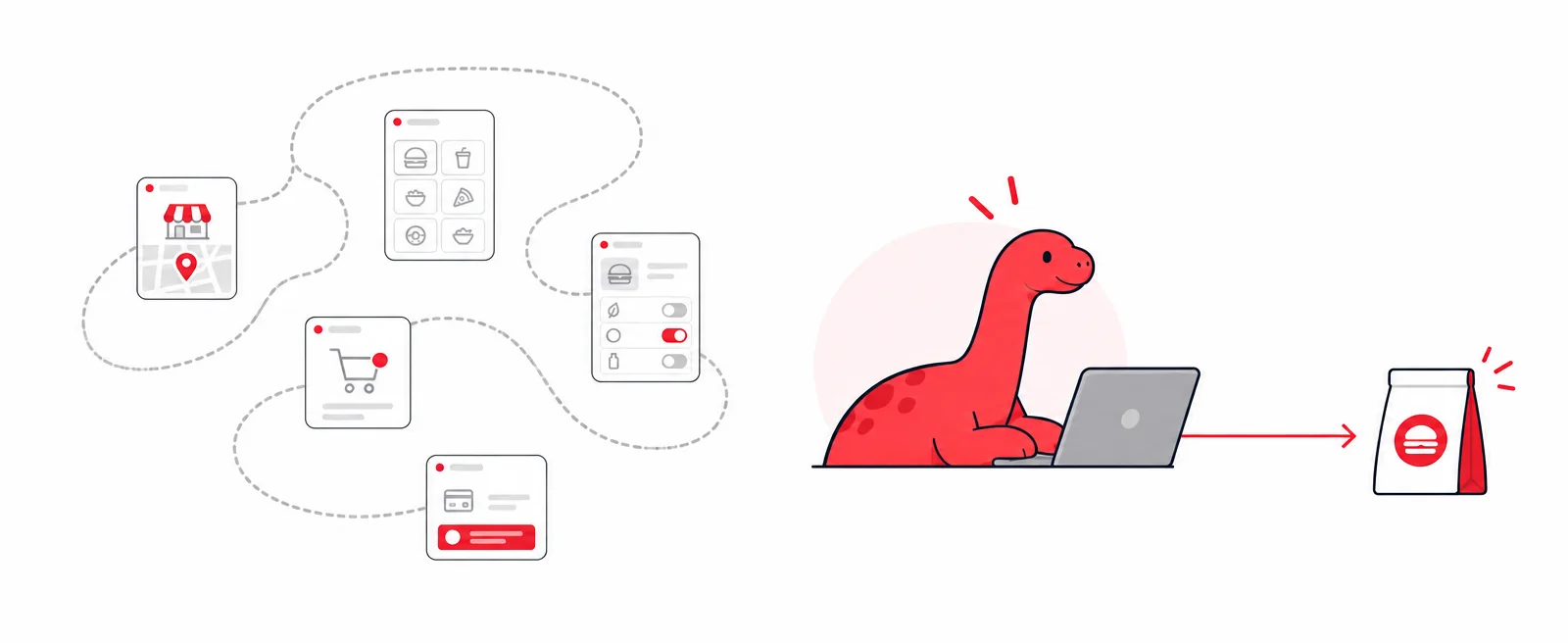
I’ve been working on a side project: an MCP server for ordering fast food. If you haven’t run into MCP yet, it’s a way to hand a model like Claude a set of tools it can use against a real system. Not a chat window bolted onto an app. Actual access to do the thing.
The interesting part wasn’t the AI. It was the mapping.
I don’t want to own anyone’s menu. I just want to map a menu to the small set of fields required to complete a purchase. Item, modifiers, location, pickup time, payment. Once that structure exists, the agent doesn’t need to be clever. It needs to be pointed at the right fields.
Why agents cut the effort to get value
Think about what ordering looks like today. Open the app. Pick a store. Find the category. Find the item. Customize it. Add to cart. Check out. Every screen is a place where someone gets distracted and leaves. I’ve spent a big chunk of my career optimizing those screens, and the best we can do is make each one a little shorter.
An agent skips the navigation entirely. “Get me my usual, ready by 6:15” is the whole interaction.
I felt the same shift at home. I built an MCP for my family’s chores app, and now I ask Claude whether the kids finished their chores instead of opening anything. I recently updated my website from a plane by directing an agent on a Mac mini back home. None of that is earth shattering. All of it changed how much effort it takes to get something done.
I was judging agents as an interface. That was the mistake. They’re a way to shorten the distance between what someone wants and the moment they get it. The app doesn’t disappear. It becomes the place you check the work, not the place you do it.
Will companies let AI agents in?
Building the connection is the easy part. The real question is whether companies will plug into it.
This week gave us a clean split. Walmart announced Agent Profiles, the Walmart Agent Gateway, and terms for AI agents, so customers can shop through the apps and agents they choose, with permissions and controls built in. Meanwhile, Amazon has blocked Perplexity’s shopping agent and Meta’s Muse. Amazon isn’t anti agent. It’s anti other people’s agents. It replaced Rufus with Alexa for Shopping, its own assistant that can answer questions and take actions for shoppers.
That’s a rational business call. If an outside agent does the browsing, you lose the ads, the upsells, and the relationship. Restaurant brands already lived through a version of this with third party delivery. Convenience won, and plenty of brands spent years trying to win the guest back from the aggregator.
So there are options. The open question is whether they meet users where they actually are. Will guests order through Claude, ChatGPT, or Gemini? Through a brand’s own assistant? Or will most of them keep tapping through the app out of habit? Walmart said it plainly: “Shopping with an agent won’t be for everyone, and it doesn’t have to be.” I think that’s the most honest line anyone has written about this so far.
And underneath all of it sits reliability. An agent that gets the order right nine times out of ten is a disaster on the tenth.
Still building
My skepticism didn’t go away. It moved. I’m no longer asking whether the technology works. I’m asking who lets it in, and whether people will actually use it once they do.
The MCP isn’t finished, and mapping one menu cleanly is very different from mapping many. But I’ve gone from “solution looking for a problem” to “this removes real effort for real people.” Whether the industry opens the door is the next thing I’m watching. I’ll keep sharing what I learn.