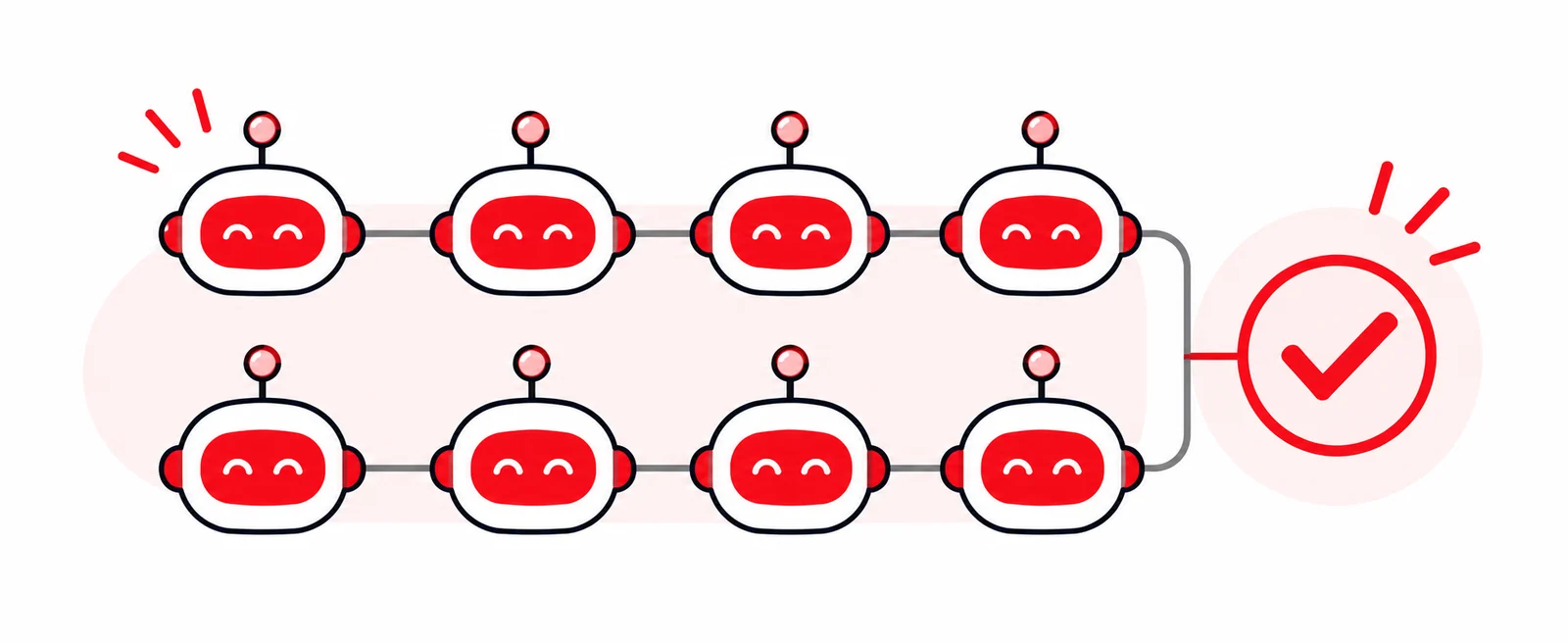
Satya Nadella has a thought experiment he keeps coming back to. Microsoft has roughly 200,000 people. What happens when they’re working in a loop with “2 million agents or 20 million agents”?
The clip is making the rounds again this week, a couple of weeks after Microsoft offered about 60,000 employees a voluntary exit. Microsoft says AI isn’t behind the buyouts, and I’m not going to read anything into the timing. The headcount debate is loud enough without me.
The question I keep coming back to is quieter. When 20 million agents do the work, who answers for it?
The org chart doesn’t have a box for agents
An org chart is an accountability map. It tells you who owns the checkout, who owns the menu, who you call when the promo breaks on a Friday night. Everyone on it can be asked, “What happened here?”
Agents aren’t on it. They do real work: draft the copy, triage the tickets, summarize the research, open the pull request. But when the work is wrong, nobody’s name is next to it unless someone put it there on purpose.
I’ve seen what happens when ownership is fuzzy between two human teams. Product thinks engineering owns it. Engineering thinks it’s a business rule. The guest finds out first. Agents make that gap wider, because “the agent did it” sounds like an answer. It isn’t.
Every agent needs three things before it touches real work
I don’t think this needs a new management theory. It needs the same discipline we already use when we delegate to people, applied without exception.
An owner. One person whose name is next to the agent, the same way a feature has a product owner. Not a team. Not “AI ops.” A person who can be asked what happened and is expected to know.
A brief. What good looks like, what the agent may do, and what it may never do. The “never” list matters most. It’s the difference between an agent that drafts an offer and an agent that changes prices in production. I’ve written about how clarity is the work, not overhead. With agents, it’s the whole job. A vague brief to a person gets a clarifying question. A vague brief to an agent gets a confident wrong answer.
A sign-off. A point where a person checks the work before it becomes real. Before it reaches a guest, a customer, a franchisee or production. Everything before that point can be as automated as you like. That one step can’t be.
What this looks like for me
I use AI agents for the content on this site. They scan the news, look at what I’ve already written, and recommend topics that fit. When I pick one, they help with research and a first draft, and flag every figure and source I need to check.
What they don’t do is decide. I choose what gets written, what gets cut and what goes out under my name. Nothing is published until I’ve read it, fixed it and pressed the button. Some recommendations I take. Most I don’t. Some drafts I rewrite half of, and some I throw out. Either way, if something wrong goes out, it’s on me, not on the agent.
That line, AI recommends and I decide, is most of the design. It’s not a limit on the agents. It’s what makes it safe to give them more to do. I can lean on them every week precisely because I know where they stop.
Span of control is about to get weird
Managers used to worry about having more than six to eight direct reports. A product manager today can have a dozen agents running work for them by Friday, and nobody will ask whether that’s too many.
It might be. The limit was never how many things you can start. It was how many things you can actually inspect. An agent can produce a week of drafts in an hour. You still read at the same speed you always did. That’s the real bottleneck now, and it’s why I keep saying volume is free and quality isn’t.
So the question for a product leader isn’t “how many agents can my team run?” It’s “how much work can my team actually stand behind?” Those numbers will drift apart fast if nobody’s watching.
Don’t let “the agent did it” become the new excuse
Here’s the failure I’d watch for. A guest gets the wrong offer, a review summary misses the real complaint, a report goes to leadership with a number nobody checked. And the post-mortem says “the model hallucinated.”
Maybe it did. That’s a cause, not an owner. The real question is why nobody caught it before it reached someone who mattered. That’s a leadership question, and it has the same answer it always had: someone owns the outcome, and they inspect what they ship.
Teams pick this up from the top. If a leader accepts “the agent did it” once, it becomes the team’s default. Leadership sets the ceiling on accountability the same way it does on everything else.
One name next to every agent
Twenty million agents is a thought experiment. Twenty million owners isn’t required. But every agent that touches real work should have one name next to it, a brief that says what it can’t do, and a person who signs off before it reaches anyone.
That’s not slowing AI down. It’s the only way I’ve found to trust it with more.