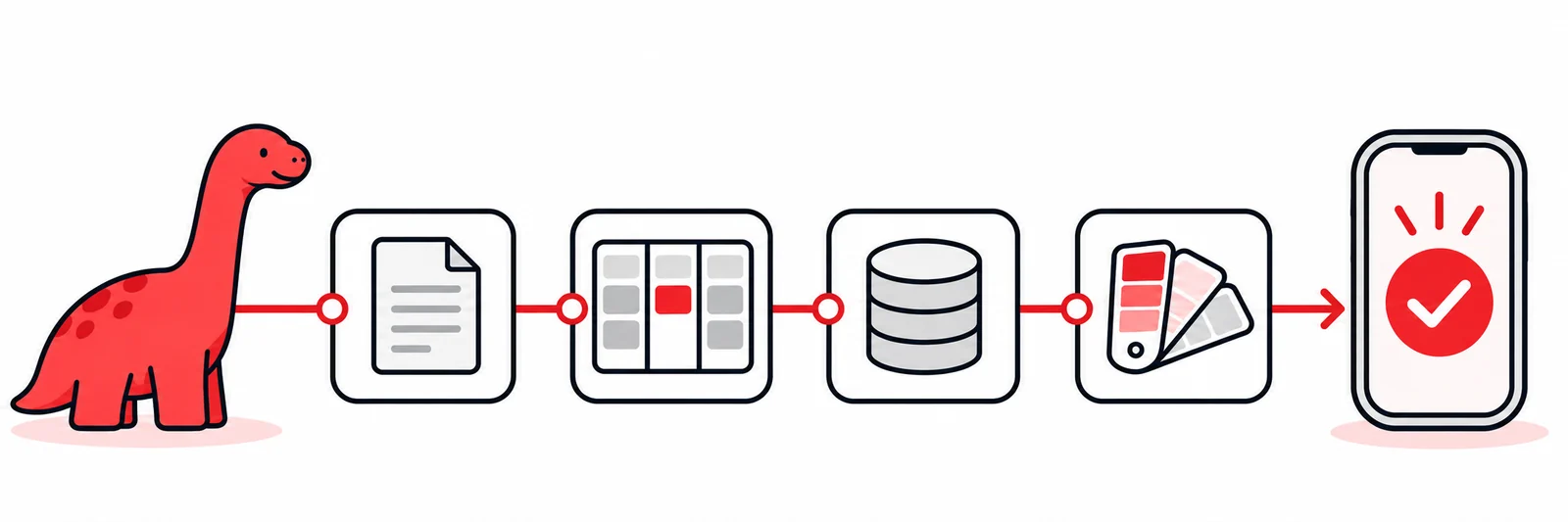
I’m building a new app, and there’s no team behind it. It’s me, Claude and a set of AI agents. I’m not ready to talk about what the app is yet, but I can talk about how I’m building it, because that part surprised me.
The first stretch of work, the foundations and accounts, is the kind of thing I’d normally plan as about two months for a small team. With just me and the agents, it got done in three days.
Not because AI wrote code fast. Because I set up a workflow where the plan, the tickets, the code, the database and the design system were all connected, and agents could move through it the way a good team does. Here’s how it works. (When I say “we” below, I mean Claude and me.)
It started with a plan, not a prompt
Before any code, Claude and I worked on the plan together. What the app is, who it’s for, what the first version has to do and what it doesn’t. Most of that time went into aligning on the outcome: what success looks like for the first release, not just a list of features. Once we agreed on that, everything else had something to point back to.
That became a product plan and a PRD, with numbered requirements.
This is the same order I’ve written about before: requirements first, then the prototype. It matters even more with agents. An agent with a vague brief doesn’t ask a clarifying question. It builds something plausible and wrong, at speed.
Then the plan became a backlog an agent could work
With the outcome set, Claude helped me turn the PRD into a real backlog in Linear: milestones from foundations through launch readiness, and about 120 tickets. Then we prioritized the sprints together. We mapped the dependencies, what has to exist before something else can be built, and flagged the blockers that had nothing to do with code, like vendor sign-ups and accounts that take days to approve. Those went first, so they’d be ready by the time the build needed them.
Each ticket was written to be worked by an agent, not just read by a person:
- Which requirements it covers, by number, so the agent can go back to the PRD.
- A “Done when” list, the specific things that have to be true.
- A definition of done: tests passing in CI, and the feature’s analytics events showing up.
- Blocking links, so the build order is explicit.
- A security flag on anything sensitive, which means a person reviews it before it merges.
That last one is the line I don’t move. The agents do the work. I’m accountable for it.
Connecting the tools
The workflow comes from connecting the tools, not from any single one. Each connection is through MCP, the same protocol I used to connect my family’s chores app to Claude.
- Linear is where the work lives. An agent picks up a ticket, reads its requirements and works against its “Done when” list.
- GitHub is where the work lands. Every ticket gets its own branch and pull request, and CI runs the tests on every change.
- Supabase is the backend: the database, auth and server functions, with separate dev and prod projects. The agents write migrations and lock down access rules like any backend engineer would.
- The design system keeps it looking like one product. Colors, type and spacing are defined once as tokens and exported to Swift and Kotlin, so the iOS app and the Android app pull from the same source.
On top of that sits an API contract that generates the client code for both apps. When the backend changes, the apps know.
What three days actually looked like
In those three days, the agents set up the backend and CI, built the data model, published the API contract with generated Swift and Kotlin clients, and exported the design tokens. Then they built the app shell, an internal admin console, analytics, rate limiting, and the full accounts and onboarding flow, from sign-up through profiles, privacy settings and account deletion.
Working day to day felt like having a project lead who never lost the thread. Claude kept the board honest and told me where everything stood: which ticket was next, which had started, which was in QA waiting on me. I’d check in, see what had moved, review what was ready and point it at the next thing. Honestly, it was a lot of fun. It’s the most I’ve enjoyed building something in years.
The plan didn’t stay frozen. As we worked through tickets, we kept finding gaps: an edge case the PRD didn’t cover, a rule that needed tightening, a piece of setup nobody had written down. Each gap became a new ticket, prioritized alongside the rest, and we closed open issues as we went instead of saving them for a cleanup phase. Code reviews did the same, usually turning up questions about who’s allowed to see what. The backlog grew while we built, and that was a good sign. It meant we were finding problems while they were cheap.
My job was the part that doesn’t compress. Deciding what came next. Reading every pull request that touched something sensitive. Saying no to things that weren’t in the plan. And catching the moments when the agent was confidently wrong, which still happens.
Why it worked
It wasn’t one magic prompt. It was a pipeline. A few things made it work:
- We aligned on the outcome before the build started. Every hour on the plan saved days later.
- The order was planned. Sprints were prioritized around dependencies and blockers, so nothing waited on something that wasn’t there yet.
- Tickets had a definition of done a machine could check. “Tests pass and the event fires” is something an agent can work toward. “Make it good” isn’t.
- The tools were connected. An agent that can read the ticket, write the code, run the migration and open the pull request doesn’t lose context between steps. That’s where a lot of a human team’s time goes.
- The backlog kept up with what we learned. Gaps became tickets the same day, not surprises at the end.
- A person stayed in the loop where it mattered. The speed came from not reviewing everything at the same depth, but I always knew exactly where I would review.
What it means for product teams
The lesson isn’t that teams are about to be replaced. The app still needs judgment on what to build, design taste, a security review and a person who answers for every release.
The lesson is that the bottleneck moved. Writing code used to be the slow part. Now it’s clarity: how well you can describe what you want, how cleanly your tools hand work to each other, and how good your judgment is about what to check. Volume is free now. Quality isn’t.
Two months into three days doesn’t come from a faster typist. It comes from a better system. And building that system is product work.