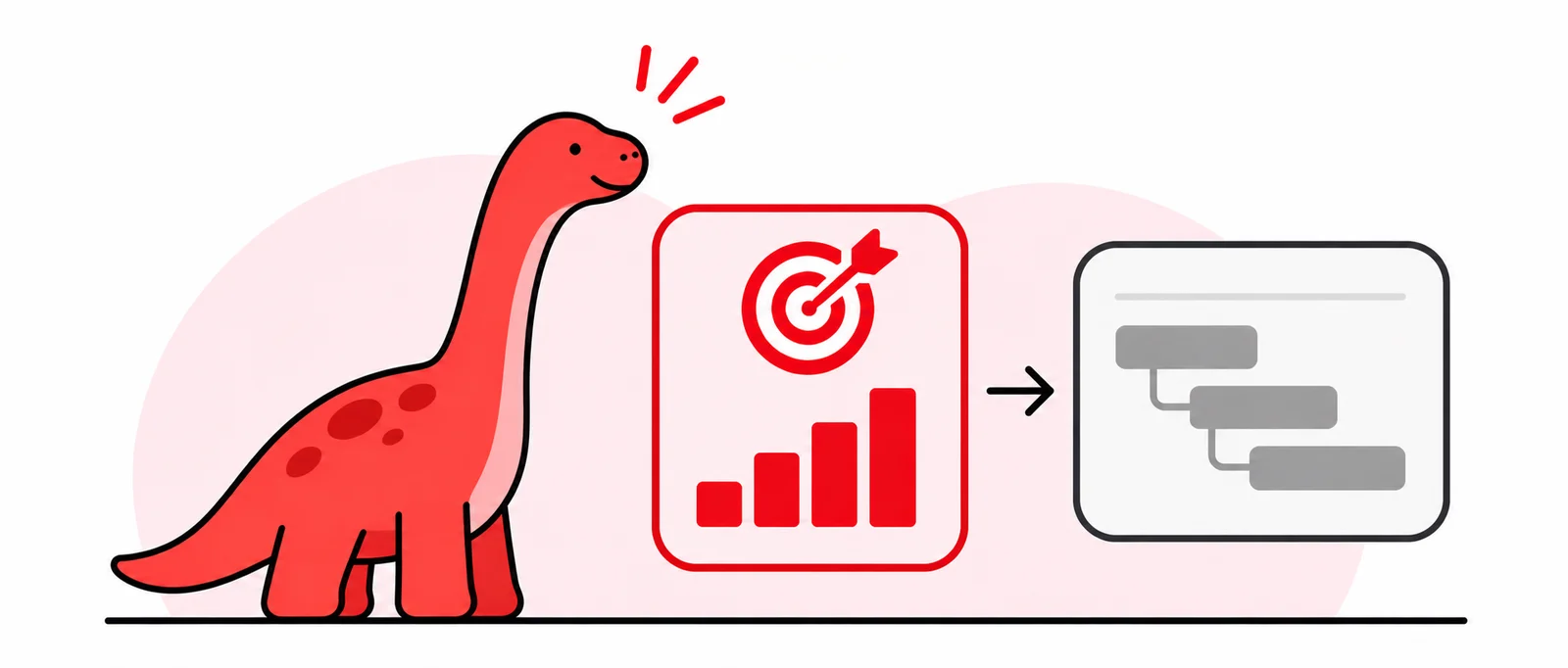
Here’s a test I run on every feature before anyone writes a requirement: how will we know it worked?
Not “we’ll look at the data.” A specific number, moving in a specific direction, by a specific date. If nobody in the room can answer, we’re not ready to write the PRD. We’re still deciding what the problem is.
I’ve come to think the metric is the most important line in the whole document, and it should be written first.
Why first
When the metric comes last, it gets reverse-engineered from the solution. The team has already decided to build a new menu layout, so the metric becomes “engagement with the new menu.” Of course that goes up. You built a new menu.
When the metric comes first, it describes the problem. “Guests take too long to get from opening the app to placing an order.” Now the menu layout is one possible answer among several, and you can compare them.
That’s what happened when we looked at ordering speed at Jack in the Box. The goal wasn’t a redesign. It was time to order. Framing it that way pointed us at the friction that had piled up across the whole flow, one field and screen at a time, and we cut ordering time in half. A redesign brief would have polished the screens and kept the steps.
Pick one metric
One. Not a scorecard of six.
With six metrics, something always goes up, and every launch is a success. With one, you have to decide what this feature is actually for. That decision is the point of the exercise, and it’s often the hardest conversation of the project.
A good primary metric is:
- Tied to a guest behavior, not a team activity. “Orders placed” beats “screens shipped.”
- Moved by this feature, not by the whole business. Total sales is real, but a dozen things move it every week.
- Readable soon. If you won’t know for a year, pick a leading indicator you’ll see in weeks.
Add a guardrail
The primary metric says what should go up. The guardrail says what must not go down.
Speed up checkout, and the guardrail might be order accuracy or average check. Push more offers, and the guardrail is margin. Make sign-in easier, and it’s fraud. Every improvement has a way of being bought with something else, and the guardrail is how you catch it before the quarterly review does.
I’ve seen plenty of features hit their number by quietly breaking something nobody was watching. The guardrail is the thing you’d be embarrassed not to have checked.
Write down the kill line
This is the part almost nobody does. Before launch, write down the result that would make you roll it back or stop investing.
“If conversion on the new flow isn’t at least flat after three weeks, we revert.” It feels pessimistic to write that down. It’s the opposite. It’s what lets you launch quickly, because everyone has agreed in advance what failure looks like, and nobody has to fight about it later with their ego on the line. I’ve written about reducing risk while launching quickly, and this is most of how.
Without a kill line, a disappointing feature lives forever. Someone always has a reason to give it one more month.
Then write the PRD
With the metric, the guardrail and the kill line agreed, the PRD gets easier. Every requirement can be tested against one question: does this help move the number? Requirements that don’t are candidates to cut. It also makes the document useful to AI tools, which do much better with a clear goal than a list of features. I walk through that in how to write a PRD with AI.
It changes the launch, too. Instead of a release that’s done when it ships, you have one that’s done when the number moves, or when you’ve learned why it didn’t.
A few traps
- Picking what’s easy to measure. Clicks are easy. Whether the guest got what they came for is harder, and it’s usually the one that matters.
- Setting a target from thin air. If you don’t have a baseline, your first job is to measure one. A target without a baseline is a guess with a decimal point.
- Letting the dashboard pick for you. Whatever’s already on the dashboard isn’t necessarily what this feature should move. The dashboard won’t save you; it only shows what someone decided to count.
- Changing the metric after launch. If the number didn’t move and the team switches to one that did, that’s not learning. Write down what happened to the original.
What I’d do Monday
Take the feature your team is about to start. Before the next planning meeting, write three lines at the top of its page: the one metric it should move, the guardrail it must not break, and the result that would make you stop.
If the team can’t agree on those three lines, that’s not a problem with the metric. It’s the most useful disagreement you’ll have all quarter, and it’s much cheaper to have it now.