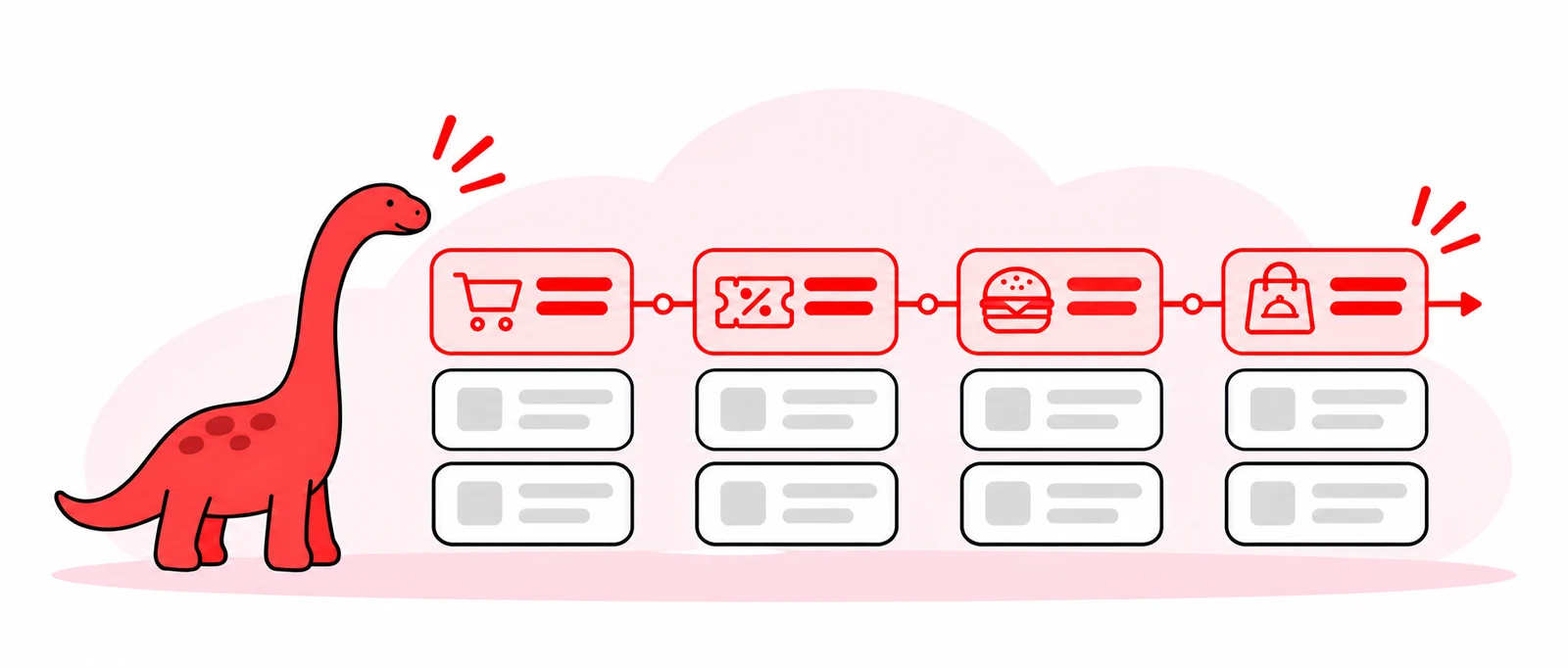
Most roadmaps I’ve seen are a list of features with dates next to them. The trouble is that a list of features can’t tell you which ones matter. Everything looks important when it’s on its own line.
My roadmaps start somewhere else. I combine two frameworks: jobs to be done, which tells me what guests are trying to get done, and MoSCoW, which sorts work into Must, Should, Could and Won’t. Each one on its own has a gap. Together they give me a roadmap I can defend line by line.
Why each framework needs the other
Jobs to be done tells me what matters, but not how much of it to build. “Find something to eat” is a job. It could take two weeks or two years, depending on how far you go.
MoSCoW tells me how much to build, but only if I know what I’m prioritizing against. Run it on a flat list of features and it turns into a negotiation. Every stakeholder’s idea is a Must, because nobody has agreed on what it’s a Must for.
So I don’t run MoSCoW on the whole backlog. I run it inside each job, for each milestone.
The rule: a Must is the minimum happy path
This is the one rule that makes it work. For each job, a Must is only what a guest needs to complete that job’s minimum happy path: the best way through it, scoped to what’s essential, not always the fewest taps. If the guest can finish the job without it, it isn’t a Must. It might be a great idea, and it might be next. But it isn’t a Must.
Take the job “find something to eat” on a restaurant ordering app. To see a menu with the right items and prices for a store, the guest has to pick a location. There are two ways in: search the store locator, or share their current location. That’s the Must. Without it, the job can’t be done at all.
Here’s how the rest of that job sorts for a first release:
- Must: pick a store by searching or by sharing location, and see that store’s menu with its own items and prices.
- Should: remember the last store, so a returning guest doesn’t start over. Show which stores are open now.
- Could: save favorite stores. A map view. Store photos.
- Won’t (this time): the parking lot. A store comparison view, and any other future idea that’s interesting but serves no guest we can point to yet.
Every one of those Shoulds and Coulds is reasonable. Some of them will matter a lot. But a guest can find something to eat without any of them, so none of them hold up the release.
Do it for every job, milestone by milestone
I repeat that sort for each job: sign in, find something to eat, redeem an offer, check out, or whatever your product’s core jobs are. Then the milestones fall out of it.
Milestone one is every job’s Musts, and nothing else. That’s the first version where a guest can get every core job done end to end, even if it’s plain. It’s usually much smaller than the team expects, which is the point.
Each milestone after that is a new sort. When milestone one ships, I run MoSCoW again within each job, against what we’ve learned. Last milestone’s Should often becomes this milestone’s Must: once guests are coming back, “remember my last store” stops being a nice touch and starts being the thing that’s slowing them down. Some Coulds get promoted. Some quietly drop to Won’t.
The order between jobs comes from the jobs themselves. Some gate others: a guest who can’t sign in can’t redeem an offer, so sign-in’s Musts go first. Then I weight what’s left by how often guests do the job and how badly it’s failing today.
Small milestones, on purpose
We work incrementally, and the milestones are kept small for a reason. Each one should show value quickly, so we can see whether it’s working the way we want before we’ve built too much on top of it.
Waiting months for one big release is the riskiest way to build. By the time guests touch it, the team has made hundreds of decisions nobody has tested, and every one of them is expensive to undo. A small milestone gets in front of guests and stakeholders in weeks. We see real usage, we hear what’s missing, and we find out early if a Must wasn’t really a Must or a Could should have been one.
It also keeps everyone level set. A working release answers questions a status update can’t: what’s done, what it does, and whether it’s moving the number we agreed on. When leadership, the team and the business are all looking at the same thing guests are using, the next sort is a much shorter conversation. It’s the same idea behind reducing risk while launching quickly: ship the smallest thing that teaches you something, then decide.
Won’t is the parking lot
Won’t doesn’t mean dead. It’s the parking lot: future ideas we’ve heard, written down and deliberately left out of this milestone. I put it on the roadmap where everyone can see it. It’s the most useful column on the page.
A visible parking lot ends the same debate before it starts again every sprint. It shows stakeholders their idea was heard and placed, not lost. And it makes it much easier to say no to a feature request, because the answer isn’t me. It’s the job, the milestone and the list we all agreed on.
Every milestone, the parking lot gets a second look with everything else. Some ideas move up to a Could or a Should once the Musts are in place. Some stay parked. A few get crossed off for good, and I tell the person who suggested them.
Where it goes wrong
- Everything becomes a Must. The fix is the rule: can the guest finish the job’s happy path without it? If yes, it’s not a Must, no matter who asked.
- Jobs that are really features. “Use the store locator” isn’t a job. “Find something to eat” is. If a job names a screen, you’ve skipped a step.
- Musts with no measure. A Must should come with a way to know it works. I write the success metric before the PRD, and for a Must that usually means the job’s completion rate.
- Sorting once and never again. The value is in re-sorting every milestone. A roadmap that never moves a Should up or a Could out isn’t learning anything.
Where I’d start
Pick one job your product supports. Write its minimum happy path as a short list of steps. Then go through everything on your roadmap that touches that job and sort it: Must if the happy path breaks without it, Should, Could or Won’t for the rest.
Then do the next job. By the third one you’ll know what your first milestone really is, and it will probably be smaller than the one on your roadmap now. To find out where your jobs are breaking today, ask guests where it’s broken. They’ll point you at the Musts.