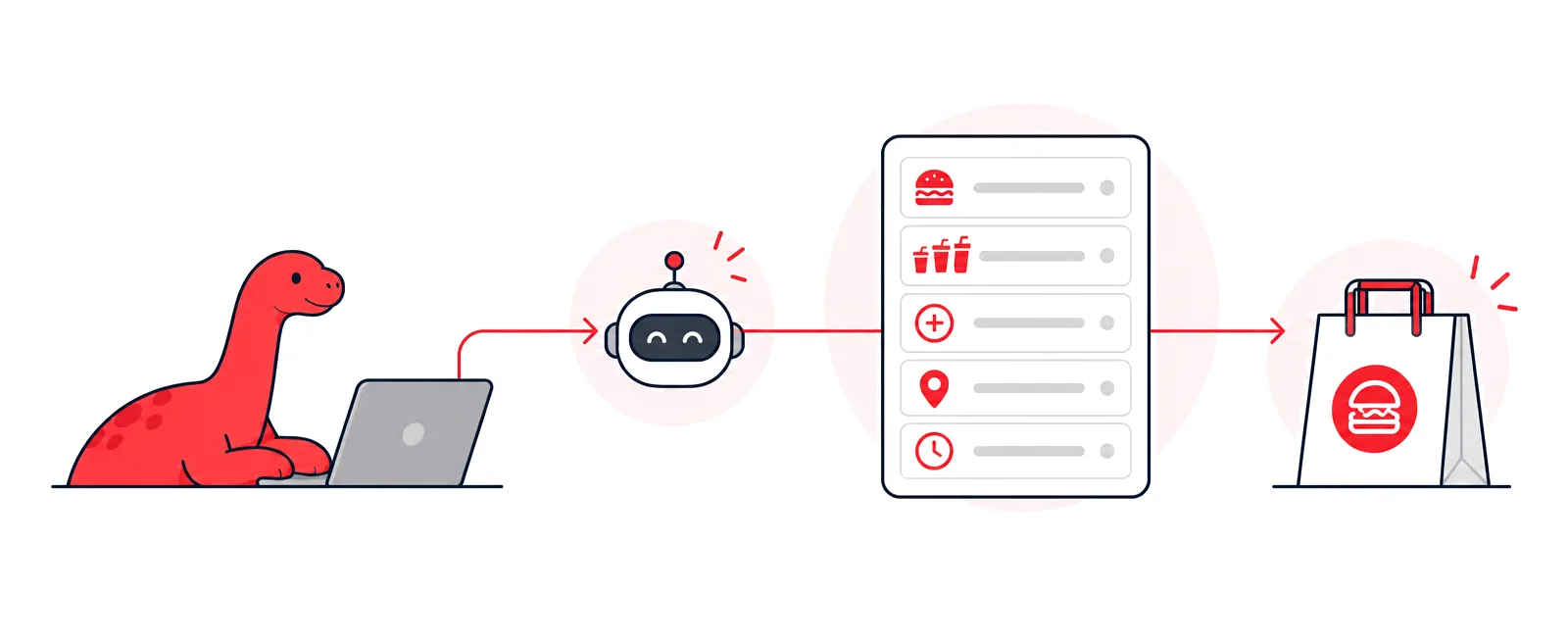
A year ago, ordering food through an AI assistant was a demo. Now it’s a channel.
In July, Square added restaurant ordering to ChatGPT and Claude. Eligible US restaurants on Square Online Ordering were opted in automatically, and the orders land in the same POS and kitchen display as every other online order. In August, Google brought ordering into Ask Maps, its Gemini-powered assistant in Google Maps, starting with Square and Toast restaurants. Papa Johns became the first partner for Google Cloud’s food ordering agent, built to take voice and text orders across its app, website, phone and, eventually, kiosks and cars. Starbucks launched a ChatGPT app in beta that helps guests pick a drink and then hands them to the Starbucks app to check out.
I’ve been building an MCP server for ordering fast food on the side, and the lesson matches what these launches show. The AI is the easy part. What decides whether an agent can order from you is everything underneath it: your menu data, your offers, your loyalty program and how you handle a mistake.
So whether you’re on Square or Toast and got opted in, or you’re a larger brand deciding whether to build your own, here’s what needs to be in place.
1. A menu an agent can read, not just a menu a person can see
Your app’s menu was designed for screens. Categories, photos, a hero item at the top. An agent ignores all of that. It needs the menu as data: every item, every size, every modifier, which choices are required, what each one costs, and what’s available at this store right now.
Most menus fall apart here. A combo that needs a drink choice, a sauce that’s only available at some stores, an item that’s sold out after 10:30. In the app, the screens enforce those rules. An agent needs them written down, or it will happily build an order the store can’t make.
The test I’d run: hand your menu data to someone who has never seen your app and ask them to build ten tricky orders. Every question they have to ask is a question an agent will get wrong.
2. Decide where checkout happens
There are two models right now, and each one is a real choice.
The agent completes the order. That’s the Square model: the guest finds a restaurant, builds the order and pays without leaving the chat. It removes the most friction, and the order still arrives as a direct order, not a marketplace one.
The agent hands off to your app. That’s the Starbucks model: the agent helps with the hard part, deciding what to get, and the guest finishes in the brand’s own checkout. You keep the payment, the upsell and the relationship. You also bring back every step the agent just removed.
Neither is wrong. But pick on purpose. If your checkout is where guests already drop off, handing them back to it isn’t a safe choice. It’s the same leak with an extra step in front of it.
3. Your loyalty program has to recognize the guest
Papa Johns’ agent recognizes Papa Rewards members and offers to repeat their recent orders. That’s the bar. A loyalty member who orders through an agent and doesn’t earn points has just learned that the agent is worse than your app.
That means three things:
- The agent can identify the member, ideally without a password. Magic links did this for our app at Jack in the Box, and the same idea works here: sign in once, stay recognized.
- Points accrue on agent orders exactly as they do in the app.
- Past orders are available, because “get me my usual” is the single best use case for an agent, and it only works if the agent knows what the usual is.
If you’re already questioning whether your loyalty program rewards the right visits, add this to the list: does it work in a channel you don’t control?
4. Offers need rules a machine can follow
Papa Johns’ rollout includes a feature that automatically applies the best-value deal. Think about what that requires. Every offer needs clear eligibility, clear stacking rules and a clear answer to “which of these is better for this order.”
Most offer systems don’t work that way. The rules live in a mix of the promo engine, the POS and the marketing team’s heads. In the app, a guest can see the offer, try it and find out it doesn’t apply. An agent will just tell them the wrong price.
At Jack in the Box, getting redemption down to one step meant connecting each offer to the products it applies to, so choosing a product on the offer adds both to the order at once. Agents raise the same question one level up. If your offers can’t be explained in plain rules, an agent can’t apply them, and I’ve written about where offer redemption usually breaks even without one.
5. Plan for the wrong order
An agent that gets the order right nine times out of ten is a disaster on the tenth. The guest doesn’t blame the AI. They blame you, at the pickup window, holding the wrong sandwich.
The safeguards are not complicated:
- Read the full order and total back before placing it, and require a clear yes.
- Make required choices actually required. If a combo needs a drink, the agent asks instead of guessing.
- Give guest support a way to see that an order came from an agent and what the agent was told.
None of this is new. It’s the same discipline as a good drive-thru order taker, applied to software.
6. Measure it as its own channel
Square reports which orders came from the new AI channels. Whatever you’re on, make sure you can do the same: orders, average check, completion rate, errors and repeat rate for agent orders, separate from the app and the website.
Early numbers will be small. That’s fine. What you want to know is whether agent orders behave like app orders, like third-party delivery orders, or like something new. That answer tells you how much to invest.
The lesson from the last time
Restaurants have been through a version of this before. Third-party delivery won on convenience, and plenty of brands spent years trying to win guests back from the aggregators.
Agents could go either way. The Square and Google launches route orders into a restaurant’s own direct ordering, not a marketplace. That’s the good version. But a brand only gets the good version if its menu, offers and loyalty are ready when guests show up, and not every guest will. Some will keep tapping through the app out of habit, and that’s fine.
If I were leading a restaurant digital team today, I wouldn’t start with an agent. I’d start with an audit: can a machine read our menu, apply our offers and recognize our members? Fix those, and you’re ready for whichever assistant your guests end up using. Skip them, and the agent will just show guests the gaps faster.