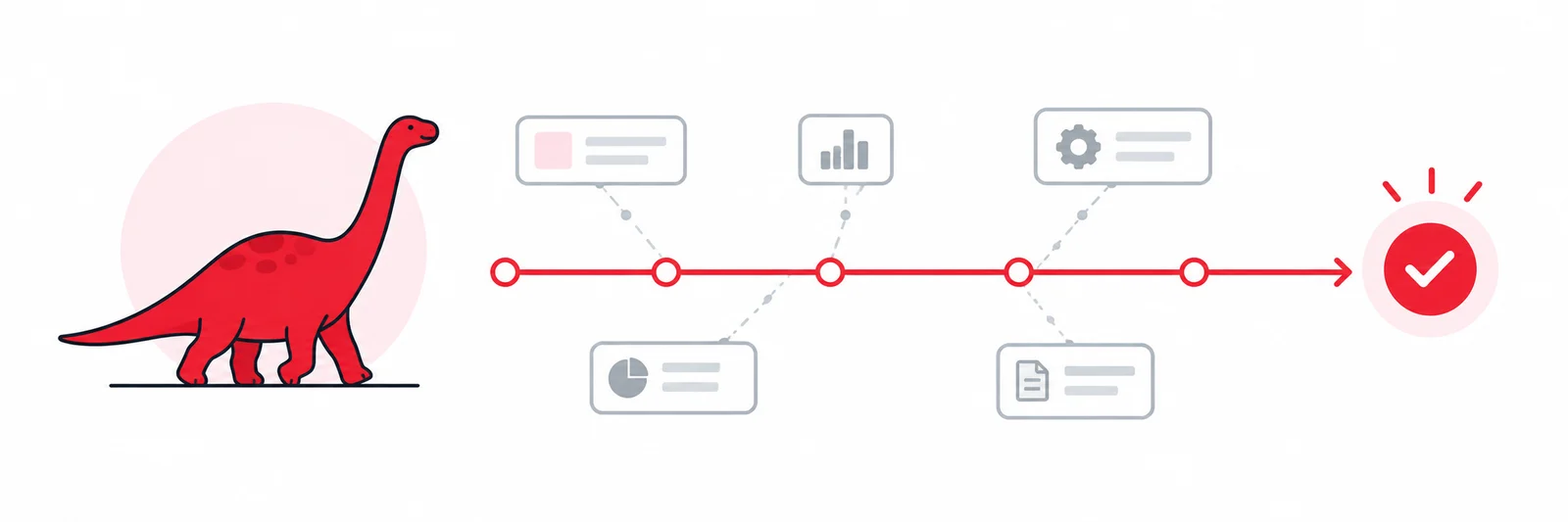
Every product has one route that most people take. A guest opens the app, picks a store, finds the thing they always get, adds it, pays and gets a confirmation. No coupon problem, no allergy question, no failed card. Just the job, done.
That’s the happy path. It’s the least glamorous part of any roadmap, and it’s where I spend time and money first.
I learned to work this way at Sonic, and I’ve applied it to everything since: apps, websites, loyalty programs, even the side projects I build with AI. It does two things for a team. It keeps everyone focused on the work that matters most, and it shows real progress sooner, because a working happy path is something you can put in front of people in weeks instead of months.
What is the happy path?
The happy path is the most effective route the most common guest takes to finish a job when nothing goes wrong. It isn’t every feature. It isn’t the edge cases. It’s the handful of steps that almost every order goes through.
On a restaurant ordering app it usually looks like this:
- Open the app.
- Pick a store, or confirm the one it remembers.
- Find the item.
- Add it, with the usual changes.
- Pay.
- Get a confirmation you trust.
It isn’t necessarily the shortest route. It’s the one scoped to work best, for the guest and the business. Confirming the store before checkout adds a tap, but it stops a guest from paying for a burger at the wrong location, so it belongs on the path. A step that only exists because of how the back end works doesn’t. The goal isn’t the fewest steps. It’s the fewest steps that still get the job done right.
How do you find the happy path?
You can’t find it without understanding what people are trying to get done. That’s why it starts with jobs to be done. Each job a guest hires the product for, like ordering, signing in or redeeming an offer, has its own happy path. Know the jobs, and you know which paths matter. Skip that step and you end up optimizing a route nobody takes.
So the time spent identifying the happy path isn’t overhead. It’s the time you spend understanding your guests: which jobs they come for, which one matters most, and the best way they’d get it done if nothing stood in the way.
Why start with the happy path?
Volume. Most of your guests, and most of your revenue, go through it. A feature used by 5% of guests can be great and still matter less than one second shaved off a step everyone takes.
It compounds. Friction on the happy path isn’t paid once. It’s paid on every order, every day. An extra screen at checkout doesn’t cost you one sale. It costs you a small share of all of them, forever, until someone removes it.
Everything else sits on top of it. Personalization, upsells, a new loyalty tier, AI features: they all assume the guest gets through the basic order. If the happy path is slow or flaky, those investments are built on a leaky bucket. The guest who drops at payment never sees the clever recommendation.
It’s measurable. You can time it, count its steps and see exactly where people drop. That makes it the easiest place to prove a return, which makes it the easiest place to defend spending money.
At Jack in the Box, we didn’t get to a 4.8-star app or cut ordering time in half by adding features. We got there by removing work from the path almost every guest takes: fields nobody needed, screens that could be one screen, offers that pulled guests out of their order. The happy path was the roadmap.
Where do teams spend instead?
Usually on the things that are easier to announce.
A new feature makes a good slide. A personalized home screen looks great in a demo. A faster checkout looks like nothing happened, which is exactly the point, and exactly why it’s hard to get funded.
The other trap is edge cases. I’ve watched teams get wrapped around the axle on them: weeks of design reviews and back-and-forth about a scenario a handful of guests will ever see, while the main flow ships late or not at all. Rare scenarios get loud advocates, because the person who hit one remembers it. They deserve fixing eventually. But a bug that hits one order in a thousand doesn’t come before a slow step that hits all of them.
What counts as part of the happy path?
This is where people get it slightly wrong. The happy path assumes nothing goes wrong, but the most common failures on that path belong to it too.
A declined card, a sold-out item, a store that just closed: if they happen often, they’re part of the happy path’s real life. Handle them well and the guest stays on the path. A rare failure in a flow almost nobody uses is an edge case, and it waits.
The test is simple: how many guests does it touch, and does it stop them from finishing the job?
How I spend on it
I work through it in the same order every time:
- Make it work. Reliability first. An order that fails at payment, an offer that won’t apply, a sign-in that loops. Nothing else matters until the path finishes every time.
- Make it fast. Then cut steps, fields and waiting. Time it on a real phone, on cellular, from a fresh account, and treat every second as a cost.
- Make it pleasant. Then the polish: remembering the last order, a clear confirmation, the small touches that make guests come back.
And one funding rule: new features don’t get money until the happy path hits its numbers. That’s how I build a roadmap with jobs to be done and MoSCoW: a Must is only what the minimum happy path needs, and it ships before anything else does. Pick the number first, too: completion rate, time to order, or failure rate at payment. I write the success metric before the PRD so the work has something to hit.
It also changes how early you can show progress. When the happy path comes first, the first working version is something you can actually use: a guest can finish the job end to end, even if it’s plain. Leadership sees it working, the team can test it with real guests, and you find out early whether you’re right. Start with the edge cases and you can spend months with nothing anyone can try.
It’s not a rule against new features. It’s a rule about order. A great new feature on a reliable, fast path pays off. The same feature on a slow, flaky path mostly reaches the guests who already made it through. Friction is invisible until you remove it, and the happy path is where most of it hides.
Where I’d start
Pick your most common job and write its happy path as five or six steps. Then go through it yourself the way a guest would: real phone, cellular, a fresh account, the most popular item.
Time it. Count every field, tap and screen. Pull the funnel for each step and find the biggest drop. Then compare that list to what’s funded right now. If the biggest drop on your happy path isn’t on the roadmap, that’s the first thing I’d move.